Currently Empty: £ 0.00

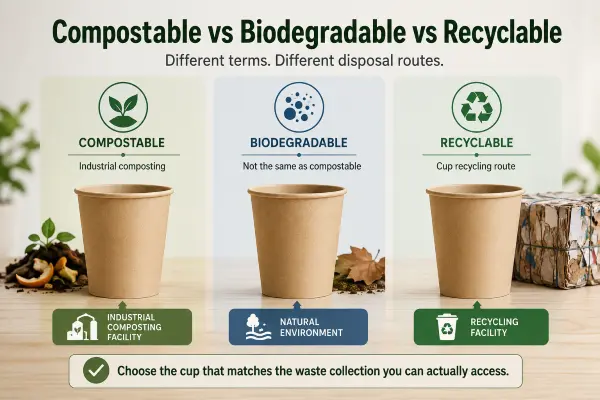
Compostable, biodegradable and recyclable are not three words for the same thing. Each names a different end-of-life route for a paper cup, each holds a different legal standing in the UK, and each asks something different of the bin you use.
A cup can carry one label and fail another, which is why the greenest-sounding option on a supplier’s page is not always the right fit for a café or takeaway. This guide separates the three terms, shows what each means under UK rules, and helps you match a cup to the waste collection you can actually reach.
It is written for foodservice buyers weighing cost against disposal, and for readers who want a clear answer rather than a slogan. EcoLife Packaging, a UK factory-direct supplier sourcing from an ISO 22000:2018 facility, sets out the facts without the marketing gloss. We start where most of the confusion starts: with the word compostable.
Compostable, Biodegradable and Recyclable Cups: What’s the Difference?
A compostable cup is certified to break down into natural matter within a set time under controlled conditions; a biodegradable cup breaks down eventually with no fixed timeframe; a recyclable cup can be pulped back into new fibre at a suitable facility. The distinction sits in certification, timing and the route each one needs.
| Term | What it means | Typical breakdown | UK disposal route |
| Compostable | Certified to decompose into CO2, water and biomass under set conditions, | 90 to 180 days (industrial) | Industrial composting, where accepted |
| Biodegradable | Broken down by micro-organisms, no guaranteed timeframe. | Undefined (months to years) | No dedicated route; often general waste |
| Recyclable | Repulped into new paper fibre at a suitable plant | Reprocessed, not decomposed | Specialist cup recovery, not standard kerbside |
Each term earns its own section. Compostable comes first, because it carries the strictest standard and the most confusion.
What Is a Compostable Paper Cup?
A compostable paper cup is one certified to break down into carbon dioxide, water and biomass under controlled composting conditions, within a defined window. The recognised European standard for this is EN 13432, which sets thresholds for disintegration and biodegradation under industrial composting.
The label rests on the certification, not on the material alone. A cup earns the term only when an accredited test shows it disintegrates and biodegrades within the standard’s limits, which is why a seedling mark or an OK compost mark counts for more than the word printed on the side. Under the CMA Green Claims Code, a bare claim without that evidence would not hold up.
Readers usually ask two follow-up questions next: how fast it breaks down, and what the lining is made of.
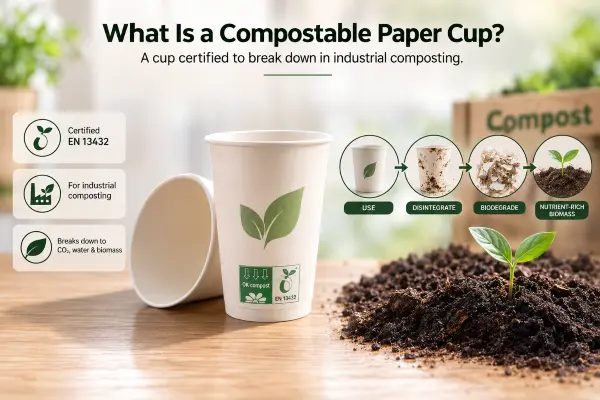
How a Compostable Cup Breaks Down (90 to 180 Days)
A certified compostable cup reaches full breakdown in roughly 90 to 180 days inside an industrial composter, where temperatures hold near 55 to 60°C with steady moisture and airflow. Those conditions do the work; a cold garden heap rarely matches them.
Home composting gives a slower and less predictable result, and many cups certified for industrial composting are not certified for home use at all. Checking your waste route before you buy keeps a batch from ending up in the wrong place.
| Setting | Typical outcome |
| Industrial composting (55 to 60°C) | Full breakdown in about 90 to 180 days |
| Home composting | Slower and uncertain; often not certified |
Breakdown only happens if the lining composts too, which turns the question to what these cups are lined with.
What Are Compostable Cups Lined With? (PLA and Water-Based Coatings)
Paper alone cannot hold a drink, so every cup carries a thin barrier on the inside. Compostable cups typically use one of two linings, each with a different effect on disposal.
- PLA: a plant-derived lining that composts industrially but softens near 85°C.
- Water-based coating: a thin aqueous layer that repulps more readily than plastic film.
- PE: the petroleum-based film fused to a standard cup, including EcoLife stock.
The lining decides both whether a cup composts and whether it recycles, so it is the detail worth checking first. EcoLife’s own paper cups use a PE lining rather than PLA or a water-based coating, and we describe them as recyclable through specialist facilities only, never as compostable. For the full contrast, see PLA vs PE Lining.
Because the lining also sets whether a cup can be recycled, it points ahead to the recyclable section
Home Compostable vs Industrially Compostable: Why the Bin Matters
Most certified compostable cups need an industrial facility, not a garden heap or a recycling bin. Put one in the wrong stream and it can spoil the batch: a compostable cup in kerbside recycling is a contaminant, and a recycling-lined cup in a compost caddy is one too.
Your local council decides what it collects, and food-waste caddies vary on whether they accept certified compostable packaging. A quick check of the council’s list settles it before a whole collection is lost.
That reliance on strict conditions is exactly what the looser term, biodegradable, lacks.
What Is a Biodegradable Paper Cup?
A biodegradable paper cup is one that micro-organisms can break down over time, with no fixed timeframe and no defined end-state. The term describes a process, not a standard, so it promises far less than it appears to.
By that loose definition an apple core and a cup that lingers for thirty years both qualify, because neither has a deadline attached. Some biodegradable plastics also fragment into smaller pieces rather than disappearing, leaving microplastic behind. That gap between the word and the outcome is why the claim draws scrutiny in the UK.
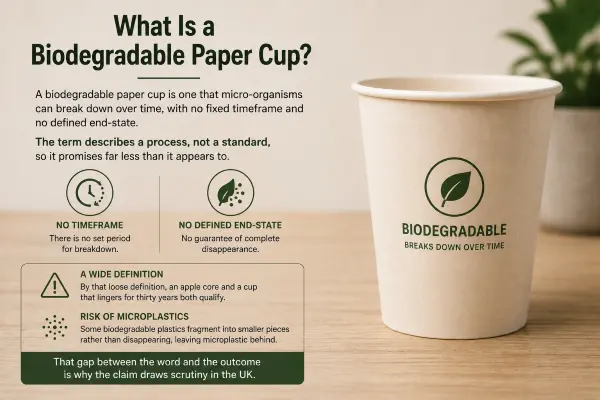
Why ‘Biodegradable’ Is an Unregulated Claim in the UK
The word biodegradable has no single legal definition in UK packaging law, which is what makes a bare claim weak. The CMA Green Claims Code requires environmental claims to be truthful, backed by evidence, and clear about any conditions, leaving out nothing that matters to the reader.
A cup marked only biodegradable, with no timeframe, no conditions and no test behind it, struggles against those tests. DEFRA has consulted on standards and labelling for compostable and biodegradable plastics, so the
position is worth reconfirming at the point of publishing. For what actually sits inside a cup, see Do Paper Cups Have Plastic.
That leaves the third term, and the one most UK readers can act on: recyclable.
What Is a Recyclable Paper Cup?
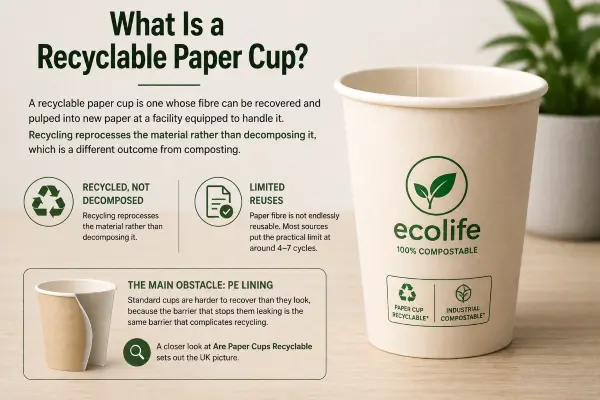
A recyclable paper cup is one whose fibre can be recovered and pulped into new paper at a facility equipped to handle it. Recycling reprocesses the material rather than decomposing it, which is a different outcome from composting.
Paper fibre is not endlessly reusable; each pass shortens the fibres, and most sources put the practical limit at around four to seven cycles before they are too short to use. Standard cups are also harder to recover than they look, because the barrier that stops them leaking is the same barrier that complicates recycling. A closer look at Are Paper Cups Recyclable sets out the UK picture.
The obstacle has a name, and it is the PE lining.
Why Standard Paper Cups Are Hard to Recycle
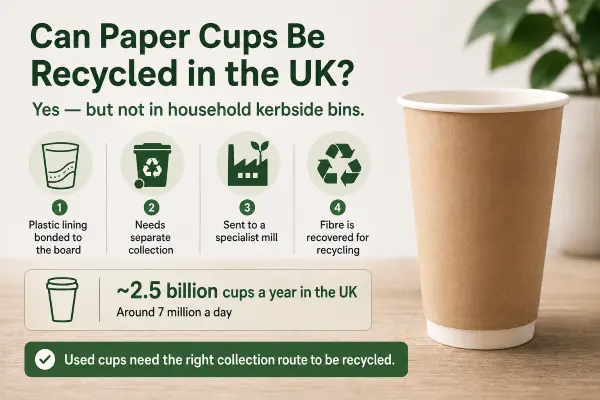
The thin polyethylene film bonded to a standard cup is what makes it awkward to recycle. Ordinary mixed-paper recycling cannot separate that plastic from the board, so most kerbside systems reject cups outright.
Recovering them takes specialist plants that split the fibre from the film using processes a standard mill does not have. That mechanical hurdle, not indifference from councils, is why only a small share of cups is recovered.
How UK Cup Recycling Schemes Actually Work
Cup recovery in the UK runs through dedicated schemes rather than the household bin. Specialist reprocessors separate the PE film from the paper fibre, and collection reaches them through a handful of routes.
- Branded take-back points in coffee chains and on high streets.
- Front-of-store collection bins in supermarkets and retailers.
- Business collection contracts that pool cups from offices and venues.
Whether your council runs any cup-specific collection is worth confirming, since most standard kerbside services still do not take them. Paper Cup Recycling (UK) covers how to route cups correctly.
How Water-Based Linings Improve Recyclability
A water-based coating repulps alongside standard paper fibre far more readily than a PE film, which widens the number of mills that can accept the cup. That single swap can move a cup from awkward to straightforward at the recovery stage.
EcoLife’s current cups use a PE lining and are recyclable through specialist facilities only, and we state that condition plainly rather than claiming kerbside acceptance. Where a water-based lined cup is available, its repulpability is the practical advantage for buyers who rely on recycling.
With all three terms defined, a side-by-side view makes the trade-offs visible at once.
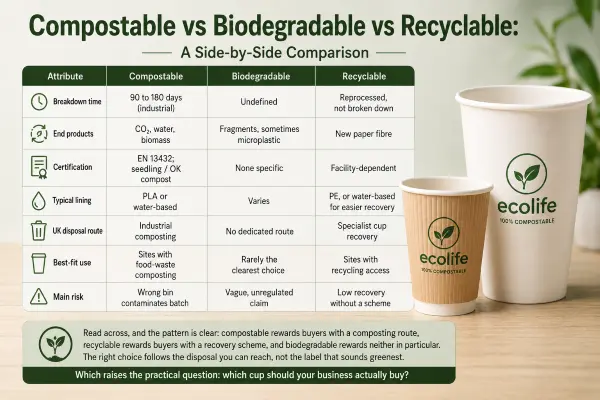
Compostable vs Biodegradable vs Recyclable: A Side-by-Side Comparison
| Attribute | Compostable | Biodegradable | Recyclable |
| Breakdown time | 90 to 180 days (industrial) | Undefined | Reprocessed, not broken down |
| End products | CO2, water, biomass | Fragments, sometimes microplastic | New paper fibre |
| Certification | EN 13432; seedling / OK compost | None specific | Facility-dependent |
| Typical lining | PLA or water-based | Varies | PE, or water-based for easier recovery |
| UK disposal route | Industrial composting | No dedicated route | Specialist cup recovery |
| Best-fit use | Sites with food-waste composting | Rarely the clearest choice | Sites with recycling access |
| Main risk | Wrong bin contaminates batch | Vague, unregulated claim | Low recovery without a scheme |
Read across, and the pattern is clear: compostable rewards buyers with a composting route, recyclable rewards buyers with a recovery scheme, and biodegradable rewards neither in particular. The right choice follows the disposal you can reach, not the label that sounds greenest.
Which raises the practical question: which cup should your business actually buy?
Which Eco Paper Cup Is Right for Your Business?
The best cup for your business is the one whose disposal route you can access, not the one with the greenest word on the label. A certified compostable cup with no composting collection nearby does less good than a recyclable cup that reaches a recovery scheme.
Three common situations cover most UK foodservice buyers, and each points to a different answer.
If You Have Access to Industrial Composting
Where your site already collects food waste and can route packaging to an industrial composter, a certified compostable cup with a PLA or water-based lining fits well. Food-led venues that separate organic waste often have this route in place, which lets the cup and the food scraps travel together.
The key is confirming the facility accepts certified packaging, since not all do. Match the certification mark to what the composter takes, and the choice holds up.
If You Rely on Standard Council Recycling
Most UK buyers sit here, and for them a recyclable cup routed to a specialist scheme is the steadier choice. A water-based lined cup recovers more easily, but even a standard cup collected through a take-back point beats a compostable cup that has nowhere to compost.
The counter-intuitive point is worth stating: the greenest label can be the worst real-world outcome when the matching bin does not exist. EcoLife supplies paper cups on this basis, recyclable through specialist facilities, with the condition stated rather than hidden.
Matching Cup Choice to Hot and Cold Drinks
Performance sits alongside disposal in the decision. A PLA lining softens near 85°C, which limits it for very hot drinks, while a double wall cup holds heat and protects the hand without a sleeve.
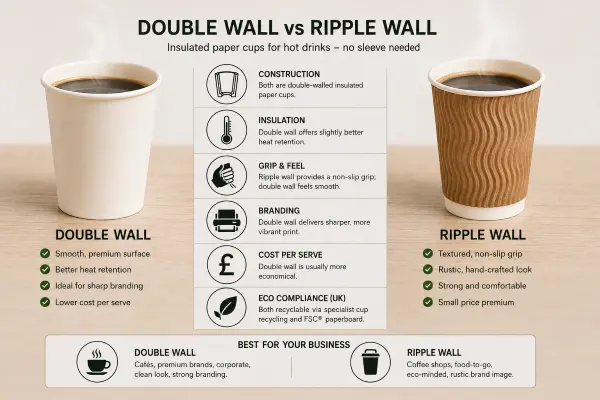
- Hot drinks: double wall or ripple wall for insulation; check the lining’s heat limit.
- Cold drinks: single wall is usually enough, with clarity mattering for iced serves.
Solving both the eco route and the thermal need at once avoids a second reorder later.
Whatever the choice, one thing separates a real claim from a hollow one: proof.
How Certifications Prove an Eco Claim (EN 13432, FSC, ISO 22000)
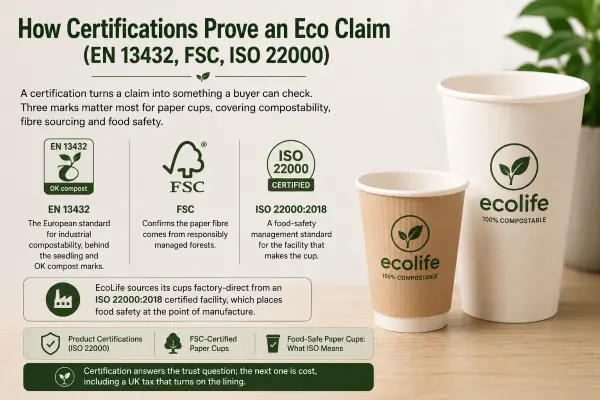
A certification turns a claim into something a buyer can check. Three marks matter most for paper cups, covering compostability, fibre sourcing and food safety.
- EN 13432: the European standard for industrial compostability, behind the seedling and OK compost marks.
- FSC: confirms the paper fibre comes from responsibly managed forests.
- ISO 22000:2018: a food-safety management standard for the facility that makes the cup.
EcoLife sources its cups factory-direct from an ISO 22000:2018 certified facility, which places food safety at the point of manufacture. See Product Certifications (ISO 22000), FSC-Certified Paper Cups and Food-Safe Paper Cups: What ISO Means for what each mark covers.
Certification answers the trust question; the next one is cost, including a UK tax that turns on the lining.
The Cost and Plastic Tax Impact of Each Cup Type
Cost splits two ways: the price per cup, and the UK Plastic Packaging Tax that lands on the plastic component. The tax applies to plastic packaging containing less than 30% recycled content, at £228.82 per tonne from 1 April 2026, according to GOV.UK.
A PE lining is a plastic component and can fall within scope; a water-based coating carries no plastic film, which changes the exposure. The per-cup effect is small given the weight involved, but it adds up across large volumes and rises most years with inflation. See UK Plastic Packaging Tax Explained and Plastic Cups vs Paper Cups (Cost & Tax) for the figures in full.
| Cup type | Lining | Plastic Packaging Tax exposure |
| Standard PE-lined | Polyethylene film | In scope if under 30% recycled content |
| Water-based lined | Aqueous coating | No plastic film component |
| Compostable (PLA) | Plant-derived PLA | Depends on classification; confirm case by case |
Cost and claims settled, the everyday question remains: which bin does each cup belong in?
How Should You Dispose of Compostable, Biodegradable and Recyclable Cups?
Disposal is where the eco benefit is won or lost, because the wrong bin cancels it out. Here is the short version for the UK, before the wider questions readers still ask.
- Compostable: industrial composting only, where your council or contractor accepts it.
- Biodegradable: no dedicated route, so usually general waste.
- Recyclable: a specialist cup scheme or take-back point, not the standard kerbside bin.
Getting the route right is the single act that makes any of these labels mean something.
From here the questions widen, from bins to the claims and terms readers meet most often.
Common Questions About Eco-Friendly Paper Cups
A few questions come up repeatedly, and short answers help settle them.
Are Paper Cups Recyclable in Standard UK Kerbside Bins?
Generally no. Standard PE-lined cups need specialist separation that ordinary kerbside recycling cannot provide, so most councils reject them. Cups with a water-based lining fare better, though acceptance still varies.
Check your council’s list before assuming a cup is collected, and use a dedicated take-back scheme where one exists.
Is Compostable the Same as Biodegradable?
No. Compostable is a certified claim with defined conditions and a timeframe, tied to a standard such as EN 13432. Biodegradable has no fixed timeframe, no guaranteed end-state and no single standard behind it. A compostable cup breaks down under the right conditions; a biodegradable one carries no such assurance.
Which Disposable Cup Is the Most Environmentally Friendly?
The greenest single-use cup is the one whose disposal route you can reach. A reusable cup beats any single-use option where it is practical; failing that, a recovered recyclable cup or a properly composted compostable cup comes next. No one label wins in the abstract, which is why access matters more than the word on the cup. Reusable vs Disposable Cups weighs the trade-off.
Can You Put Compostable Cups in Your Food Waste Bin?
Usually not, unless your council states it accepts certified compostable packaging in the food-waste caddy. Most caddies are for food only, and a stray cup can contaminate the collection. Route certified compostable cups to industrial composting instead, and check the council’s guidance first.
What Is a Plastic-Free Paper Cup?
A plastic-free paper cup uses a water-based, aqueous barrier in place of a PE or PLA film, so no plastic layer remains in the cup wall. That construction repulps more easily and can widen recycling acceptance. The term describes the lining, not the compostability, so it is a separate quality from compostable. What is plastic-free paper cup explains the construction.
Which Eco Claims to Avoid: Spotting Greenwashing in Paper Cups
Choosing the right cup means recognising the wrong claim. A few red flags mark a claim worth questioning, and each ties back to the CMA Green Claims Code test of truth, evidence and clarity.
- Bare biodegradable, with no timeframe or conditions attached.
- Eco or eco-friendly used with no standard or reason behind it.
- Recyclable stated with no accessible route named.
- Missing or unnamed certification marks.
A trustworthy supplier states the condition, not just the claim: recyclable through specialist facilities, certified to a named standard, sourced from an audited facility. EcoLife sets its paper cups out on those terms, with the facts a buyer can check rather than a slogan.